




Advantages of large backdrops for professional photography
Choosing the right backdrop size can make or break your photography session. Too small, and you’re stuck with awkward cropping and limited framing options. Too large, and you might wonder if the investment is worth it. Large backdrops solve critical studio challenges by providing greater framing flexibility, superior lighting control, and mechanical stability that smaller options simply can’t match. Understanding these advantages helps you make informed decisions that elevate your photography quality while streamlining your workflow and reducing post-production headaches.
Table of Contents
- Key takeaways
- Greater framing flexibility for diverse subjects
- Improved lighting and subject separation
- Mechanical stability and durability advantages
- Enhanced efficiency and reduced post-production effort
- Explore premium large backdrops for your studio
- Frequently asked questions about large photography backdrops
Key Takeaways
| Point | Details |
|---|---|
| Framing flexibility | Large backdrops offer more room for full length portraits and groups, reducing edge cropping and enabling natural poses. |
| Lighting control | Increased distance between subject and backdrop improves light diffusion and separation, resulting in softer lighting and fewer shadows. |
| Workflow efficiency | Larger backdrops offer mechanical stability and streamline workflow by reducing repositioning and setup time. |
| Sizing buffer | Always choose backdrop sizes slightly larger than the calculated minimum to provide a buffer for unexpected poses. |
| Size guidance | The article lists recommended sizes for individuals 5x7 to 8x10, couples and small families 8x10, groups 10x12 or larger, large bridal parties 9x20 or larger, and product photography 8x10. |
Greater framing flexibility for diverse subjects
Large backdrops provide greater framing flexibility for full-length portraits, groups, families, and bridal parties, avoiding edge cropping and allowing creative movement. When you’re shooting a family of five or a bridal party of eight, a standard 5x7 foot backdrop forces you into tight compositions that feel cramped and unnatural. Your subjects can’t move freely, and you’re constantly worried about limbs or fabric extending beyond the frame.
Switching to larger formats transforms your shooting experience. An 8x10 foot backdrop comfortably accommodates groups of four to six people with room for natural poses and slight movements. For larger gatherings like extended families or full wedding parties, 9x20 foot or larger backdrops become essential tools. These dimensions give you breathing room to experiment with different angles, allow subjects to shift positions without stepping out of frame, and create compositions that feel spacious rather than confined.
Consider these recommended backdrop sizes for different scenarios:
- Individual portraits and headshots: 5x7 feet minimum, 8x10 feet preferred for full-length shots
- Couples and small families: 8x10 feet for comfortable framing with movement space
- Groups of 4 to 6 people: 10x12 feet to prevent edge anxiety and enable dynamic posing
- Large groups and bridal parties: 9x20 feet or larger for professional event coverage
- Commercial product photography: 8x10 feet minimum to accommodate various product sizes and angles
The flexibility extends beyond just fitting more people in frame. Large backdrops let you experiment with camera angles without constantly repositioning your setup. Shoot from higher or lower perspectives, move closer or farther from your subjects, and switch between portrait and landscape orientations without worrying about backdrop edges appearing in your shot.
Pro Tip: Always choose backdrop sizes slightly larger than your calculated minimum. This buffer zone saves you when subjects strike unexpected poses, children move unpredictably during family sessions, or you decide to try a creative angle mid-shoot. The extra footage pays for itself in reduced stress and expanded creative options.
Improved lighting and subject separation
Larger sizes enable proper subject-backdrop distance of 3 to 6 feet or 10 feet minimum, preventing shadows, improving separation, and better light diffusion. This spacing is where large backdrops truly shine, creating the professional look that separates amateur snapshots from polished studio work. When your subject stands too close to the backdrop, every light source casts harsh shadows that create distracting dark spots and uneven tones.
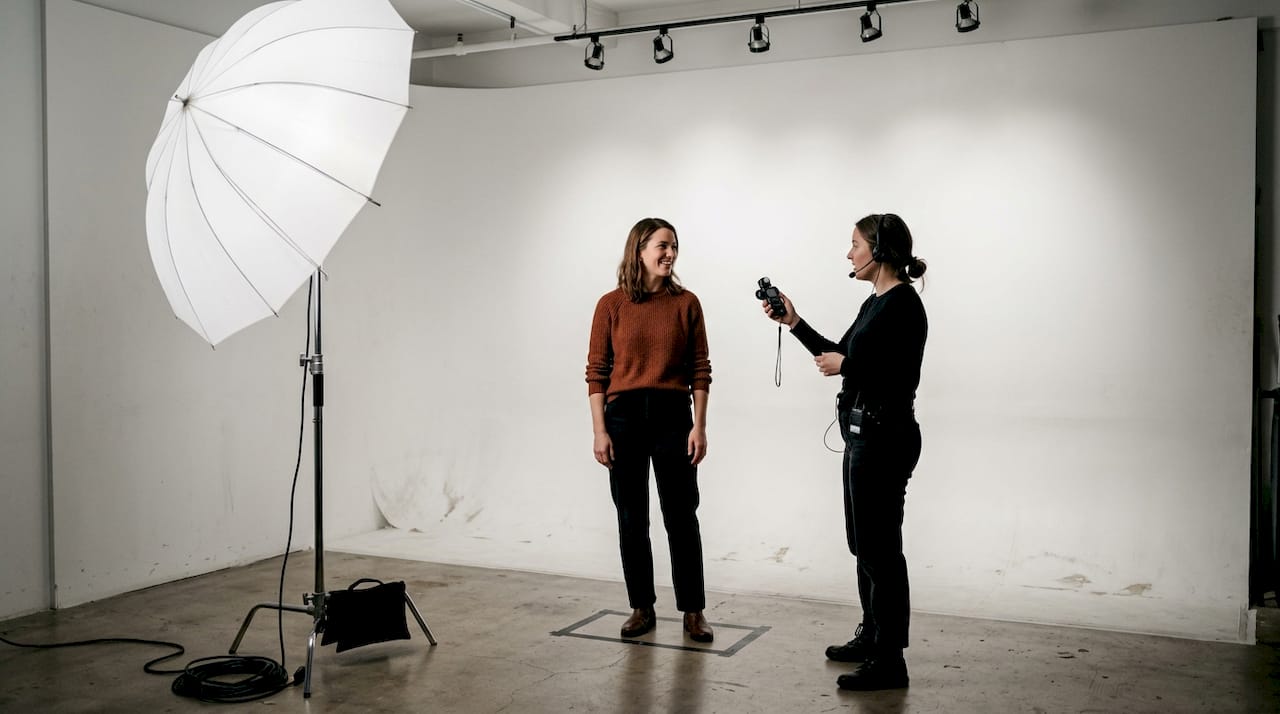
The physics are straightforward but critical. Light behaves predictably: the farther it travels, the more it diffuses and softens. When you position your subject 5 feet from a large backdrop instead of 2 feet from a smaller one, those extra 3 feet allow light to spread and soften before hitting the background. Shadows become subtle gradients rather than sharp edges, and your subject appears naturally separated from the background without heavy post-production work.
Follow these steps for optimal lighting setup with large backdrops:
- Position your backdrop with at least 6 feet of floor space in front for subject placement and movement
- Place your subject 4 to 6 feet from the backdrop surface to minimize shadow transfer
- Set your key light at a 45-degree angle to your subject, maintaining distance from the backdrop
- Add a backdrop light aimed at the background from behind and to the side of your subject
- Use a fill light or reflector on the opposite side of your key light to balance facial shadows
- Test your setup by checking for shadow separation between subject and backdrop edges
Professional photographers consistently emphasize that proper subject-backdrop distance matters more than expensive lighting equipment. A large backdrop that allows 5 to 6 feet of working space delivers better results with basic lights than a cramped setup with premium gear.
This separation creates depth in your images that viewers perceive as professional quality, even if they can’t articulate why. The subtle gradient from your subject’s outline to the backdrop adds dimensionality that flat, shadow-heavy images lack. For product photography, this separation ensures your items appear to float naturally against the background rather than sitting awkwardly on a surface with visible shadows.
Mechanical stability and durability advantages
Proper grommet spacing of every 12 inches prevents sagging such as 1.5-inch bow at 10 foot width and ensures even tension. Large backdrops face unique mechanical challenges that smaller formats don’t encounter. A 5-foot wide backdrop hangs relatively flat under its own weight, but stretch that same material to 10 or 12 feet, and physics demands better engineering.
The relationship between width and sag potential follows predictable patterns:
| Backdrop Width | Grommet Spacing | Potential Sag Without Support | Tension Stability |
|---|---|---|---|
| 5 feet | 18 inches | 0.5 inches | Excellent |
| 8 feet | 12 inches | 1.0 inches | Good |
| 10 feet | 12 inches | 1.5 inches | Requires attention |
| 12+ feet | 8-10 inches | 2+ inches | Needs reinforcement |
Quality manufacturers understand these physics and design large backdrops with reinforced edges and strategic grommet placement. When grommets are spaced every 12 inches or closer, the weight distributes evenly across multiple support points rather than concentrating stress on a few areas. This even distribution prevents the material from stretching unevenly, which causes permanent deformation and wrinkles that ruin your professional appearance.
Material weight also plays a crucial role in stability. Heavier vinyl backdrops (16-20 oz per square yard) hang straighter and resist wind from fans or movement better than lightweight alternatives. The additional weight might seem like a drawback for portability, but it delivers superior results when mounted. The backdrop stays put during shoots, doesn’t flutter or ripple when people walk nearby, and maintains consistent tension that keeps wrinkles minimal.
Consider how tension stability affects your backdrop selection for professional photography. A backdrop that sags in the middle creates visible curves and distortions that show up in your images, especially when shooting straight-on or with shallow depth of field. Even subtle bowing can cause lighting inconsistencies as the curved surface reflects light differently than a flat plane.
Pro Tip: Inspect grommet reinforcement before purchasing large backdrops. Quality backdrops feature metal grommets with reinforced fabric rings that prevent tearing under tension. Cheap alternatives use simple punched holes that rip within months of regular use, destroying your investment and forcing emergency replacements mid-project.
Enhanced efficiency and reduced post-production effort
E-commerce operations switched to large vinyl backdrops and cut retakes by 73% via reduced wrinkles and better white balance stability. This dramatic improvement isn’t an isolated case. Multiple studios report similar efficiency gains when they upgrade from smaller, lower-quality backdrops to professional large formats. The time savings compound across every shoot, turning what seemed like a significant upfront investment into a cost-saving decision within months.
The efficiency gains break down into several measurable categories. First, wrinkle reduction means fewer shots ruined by visible creases that require clone stamping or content-aware fill in post-production. Large vinyl backdrops hang with minimal wrinkles due to their weight and proper tension distribution, unlike fabric alternatives that crease easily and require steaming before every session.
Second, color stability across the larger surface area eliminates the frustration of mismatched tones when you need to composite multiple shots or maintain consistency across a product line. Smaller backdrops often show color variations between different production batches, but quality large backdrops come from single print runs that ensure uniform color from edge to edge.
Third, reduced cropping needs mean you capture more usable area in every frame. When you’re not worried about backdrop edges creeping into your shot, you can frame more loosely during capture and make final cropping decisions during editing with full flexibility.
Real-world efficiency metrics from studio case studies:
| Metric | Before Large Backdrops | After Large Backdrops | Improvement |
|---|---|---|---|
| Average retakes per session | 8.5 shots | 2.3 shots | 73% reduction |
| Post-production time per image | 12 minutes | 4.5 minutes | 62% faster |
| Wrinkle removal edits | 85% of images | 8% of images | 91% decrease |
| Color correction needs | 92% of images | 31% of images | 66% decrease |
Maintain these efficiency advantages with proper backdrop care:
- Roll backdrops loosely rather than folding to prevent permanent creases
- Store in climate-controlled spaces to prevent material degradation and color shifts
- Clean spills immediately with appropriate cleaners to maintain surface consistency
- Rotate between multiple backdrops to extend lifespan and prevent overuse wear
- Inspect grommets and edges monthly for early signs of stress or damage
The workflow improvements extend beyond just the technical aspects. When you’re confident your backdrop will perform consistently, you spend less mental energy worrying about technical problems and more creative energy directing subjects, adjusting compositions, and capturing compelling moments. This psychological shift might seem minor, but it transforms your shooting experience from stressful problem-solving to enjoyable creative work.
Explore premium large backdrops for your studio
Now that you understand how large backdrops transform your photography through superior framing flexibility, lighting control, mechanical stability, and workflow efficiency, it’s time to experience these advantages firsthand. Instant Backdrops specializes in professional-grade vinyl backdrops engineered specifically for the demands you face daily.
Our large format backdrops feature the reinforced construction and precise grommet spacing discussed earlier, ensuring your investment delivers consistent performance for years. Whether you need realistic marble textures for product photography, warm wood tones for lifestyle content, or clean solid colors for portraits, our collection provides the size and quality professional photographers demand. Each backdrop ships ready to hang with vibrant, high-resolution prints that maintain color accuracy under studio lighting and withstand the inevitable spills and wear of active shooting environments.
Frequently asked questions about large photography backdrops
What size backdrop is ideal for full-length portraits?
For individual full-length portraits, an 8x10 foot backdrop provides comfortable framing with room for natural poses and slight movements. This size prevents edge anxiety and allows you to shoot from various angles without constantly repositioning your setup. If you frequently photograph couples or want extra creative flexibility, consider 10x12 feet as your standard.
How far should a subject stand from a backdrop?
Position your subject 4 to 6 feet from the backdrop surface for optimal results. This distance prevents shadow transfer, improves visual separation, and allows better light diffusion across the background. For high-key white backgrounds, increase the distance to 8 to 10 feet and add dedicated backdrop lighting to achieve pure white without blowing out your subject.
Why is grommet spacing important?
Grommet spacing directly affects how evenly your backdrop hangs and how long it lasts. Proper spacing of 12 inches or less distributes weight across multiple support points, preventing sagging and uneven tension that causes wrinkles. Wider grommet spacing concentrates stress on fewer points, leading to material stretching, permanent deformation, and eventual tearing at the grommet locations.
How can large backdrops reduce editing time?
Large backdrops reduce editing time by eliminating common problems that require post-production fixes. They hang with fewer wrinkles due to better weight distribution, provide consistent color across the entire surface, and eliminate edge cropping that forces you to composite multiple shots. Studios report up to 62% faster editing when switching from smaller, lower-quality backdrops to professional large formats.
Are large backdrops suitable for small studios?
Yes, large backdrops work well in small studios when mounted properly. Use ceiling or wall-mounted backdrop support systems that allow you to roll the backdrop up when not in use, maximizing your floor space. The key is choosing backdrops sized appropriately for your typical subjects while ensuring you have at least 6 feet of floor space in front for proper subject positioning and lighting setup.