








What is e-commerce photography? A complete guide
TL;DR:
- Backdrops actively shape perception, mood, and brand consistency in e-commerce photography.
- Choosing durable, easy-to-clean materials like vinyl improves efficiency and reduces postproduction time.
- Strategic backdrop selection leads to faster shoots, fewer retakes, and higher sales conversion rates.
Most photographers know that visuals sell products. But 93% of consumers consider visuals crucial for purchase decisions, yet many photographers still treat e-commerce work like any other product shoot. That gap is where sales are lost. E-commerce photography is its own discipline, shaped by platform requirements, buyer psychology, and the need for absolute consistency. And at the center of every successful e-commerce image sits one often-overlooked element: the backdrop. This guide breaks down what e-commerce photography really is, what makes it work, and how intentional backdrop choices can directly improve your results and your clients’ conversion rates.
Table of Contents
- Defining e-commerce photography: What sets it apart
- Key elements of effective e-commerce product photos
- Choosing the right backdrop: Materials, styles, and impact on results
- Practical workflow: From shoot setup to online-ready images
- Why backdrop choice is the hidden secret to standout e-commerce images
- Upgrade your e-commerce shoots with professional backdrops
- Frequently asked questions
Key Takeaways
| Point | Details |
|---|---|
| E-commerce needs unique visuals | Photos for online stores require clarity, consistency, and strategic backdrops to win buyer trust. |
| Backdrop choice impacts workflow | Selecting the right material and color reduces editing time and streamlines photo shoots. |
| Workflow matters | A step-by-step shooting and editing process leads to more efficient, repeatable results for clients. |
| Professional backdrops boost sales | Investing in quality, easy-to-use backdrops consistently elevates conversion rates in e-commerce. |
Defining e-commerce photography: What sets it apart
E-commerce photography is the specialized creation of product visuals designed for online selling. That sounds simple, but the implications run deep. Unlike editorial or lifestyle photography, e-commerce images must communicate product details clearly, load fast on web pages, and remain consistent across an entire catalog.
Here is how the main types of product-focused photography compare:
| Type | Primary goal | Background style | Consistency need |
|---|---|---|---|
| E-commerce | Drive online sales | Clean, standardized | Very high |
| Catalog | Print or digital listing | Neutral, controlled | High |
| Lifestyle | Inspire and connect | Contextual, styled | Moderate |
| Editorial | Tell a story | Creative, varied | Low |
E-commerce photography sits at the most controlled end of the spectrum. Platforms like Amazon, Shopify, and Etsy each have specific image requirements. Buyers cannot touch or try the product. Every visual cue must do the work that an in-store experience would normally handle.
Backdrops and controlled environments play a central role here. A distracting or inconsistent background pulls attention away from the product. It also signals a lack of professionalism, which erodes buyer trust fast. Exploring backdrops for e-commerce sellers shows how much background choice shapes the entire feel of a product listing.
Key characteristics that define strong e-commerce photography:
- Consistency: Every image in a catalog should feel like it belongs together.
- Clarity: Details, textures, and colors must be accurate and easy to read.
- Brand alignment: Background, lighting, and styling should reflect the seller’s identity.
- Platform compliance: Images must meet size, ratio, and background requirements.
Understanding the backdrop importance in product photography helps explain why even minor background choices have outsized effects on click-through rates. Image optimization for Amazon also highlights how technical image quality connects directly to search visibility and sales performance.
In short, e-commerce photography is not just about making products look good. It is about making them sell.
Key elements of effective e-commerce product photos
Understanding what defines e-commerce photography sets the stage for examining what actually works in compelling product visuals. Five elements consistently separate high-converting images from forgettable ones.
- Lighting: Soft, diffused light removes harsh shadows and ensures every product detail reads clearly. Harsh directional lighting creates unflattering shadows that confuse the eye and hide product features.
- Backdrop: A neutral or context-appropriate background lets the product breathe. Distraction-free backgrounds increase professional appeal and build buyer trust.
- Angles: Online buyers cannot pick up a product. Multiple angles, including top-down, front-facing, and detail shots, give them the confidence to purchase.
- Styling: Props and surface choices should support the product story without competing with it. Less is almost always more.
- Postproduction: Color accuracy, dust removal, and clean cropping are non-negotiable. Even a great shot loses impact with sloppy editing.
“The backdrop is not just a background. It is the silent context that tells buyers whether this product belongs in their life.”
Comparing muslin vs vinyl backdrops reveals real differences in how each material performs under studio lighting. Muslin can wrinkle and absorb spills, while vinyl stays smooth, wipes clean, and holds color accurately under repeated use.
Pro Tip: If you are shooting multiple products in a single session, vinyl backdrops save significant time. No ironing, no stain removal, no inconsistency between shots. The vinyl backdrops cleanup benefits alone can cut your session time noticeably.
Getting these five elements right does not require a massive studio. A clean backdrop, two diffused light sources, and a tripod will take you further than expensive gear on a cluttered background.

Choosing the right backdrop: Materials, styles, and impact on results
With foundational elements in mind, choosing the right backdrop can make or break your e-commerce photo session. Not all backdrops are created equal, and the material you choose affects everything from editing time to final image quality.
Here is a quick comparison of the most common backdrop materials:
| Material | Durability | Easy to clean | Cost | Best for |
|---|---|---|---|---|
| Vinyl | High | Yes | Medium | Product, food, jewelry |
| Muslin | Medium | No | Low | Portraits, lifestyle |
| Paper seamless | Low | No | Low | Fashion, quick shoots |
| Fabric | Medium | Varies | Medium | Lifestyle, editorial |
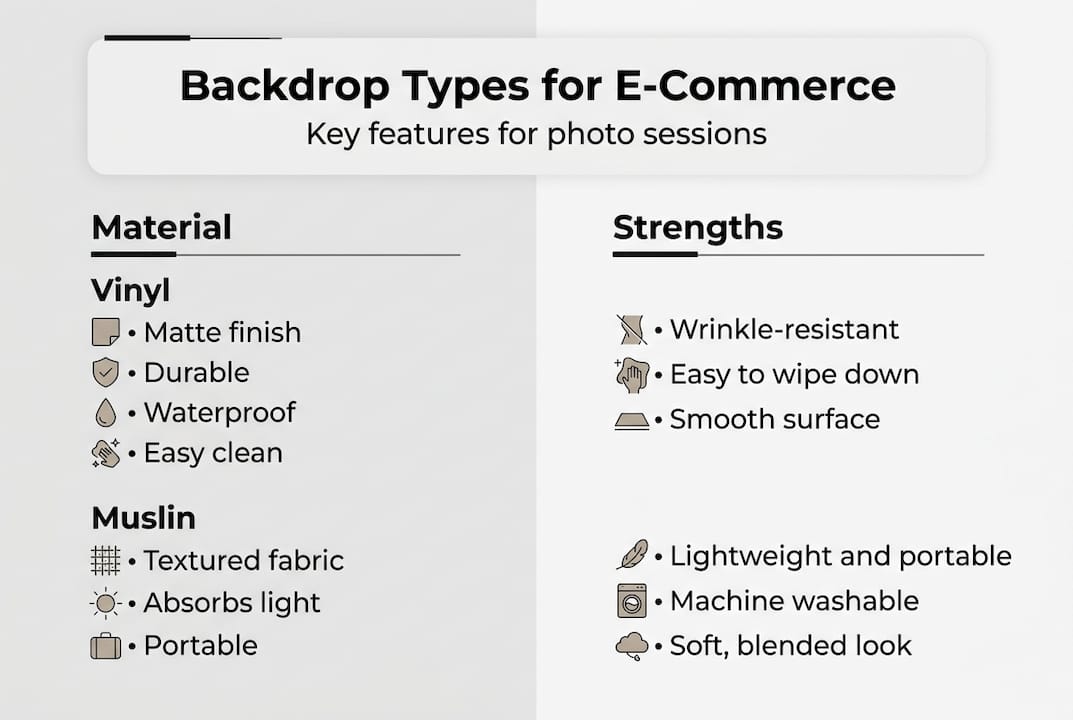
The choice of backdrop material can reduce postproduction by over 60%. That is a significant time saving across a busy shooting schedule. Vinyl, in particular, delivers consistent color and texture with minimal maintenance.
When matching backdrop style to product and brand, consider these factors:
- White and light neutrals: Ideal for clarity and platform compliance. Works for most product categories.
- Textured surfaces (marble, wood, stone): Add warmth and context. Great for food, lifestyle, and artisan products.
- Bold or branded colors: Make a strong visual statement. Best used when the brand identity is well established.
Exploring the full range of background types for product photography gives you a clearer picture of which styles suit different product categories. The guide to pro backdrops goes deeper into matching backdrop aesthetics to brand positioning.
For home studio setup tips, even a compact space can produce professional results when the backdrop is chosen thoughtfully.
Pro Tip: Before committing to a backdrop purchase, order swatch cards or request samples. Testing color under your specific lighting setup prevents expensive mismatches between what you see on screen and what actually appears in your images.
Practical workflow: From shoot setup to online-ready images
Effective backdrop selection leads directly into building an efficient, repeatable workflow for professional results. A consistent process is what separates photographers who deliver quickly and reliably from those who struggle with every new client.
Here is a straightforward workflow that works across most e-commerce shoots:
- Prepare the product: Wipe down surfaces, remove price tags, and check for dust or smudges. Small imperfections are magnified under studio lighting.
- Select and set up your backdrop: Position your vinyl or chosen backdrop flat and wrinkle-free. Secure edges to prevent shifting mid-session.
- Set your lighting: Use diffused lights positioned at 45-degree angles to the product. Avoid direct overhead lighting, which creates harsh shadows.
- Mount your camera on a tripod: Standardized camera height and angle across shots ensures catalog consistency. Lock your settings once you find the right exposure.
- Capture multiple views: Shoot front, back, sides, top-down, and close-up detail shots for each product. Give buyers every angle they need.
- Edit in batches: Systematic shoot setups reduce errors and save considerable postproduction time. Batch editing color corrections and background cleanup across a full SKU set is far faster than editing one image at a time.
- Export for web: Save files in the correct format and resolution for each platform. JPEG at 72 to 96 DPI works for most e-commerce sites, while some platforms require specific pixel dimensions.
For photographers interested in building their own custom surfaces, creating pro backdrops at home is a practical option for unique textures. Pairing custom surfaces with a reliable vinyl base gives you flexibility without sacrificing consistency.
Pro Tip: Bulk edit your backgrounds in one dedicated session after shooting. Applying the same adjustments to an entire batch keeps your catalog visually unified and cuts total editing time significantly. Optimizing e-commerce images for platform-specific requirements in the same session keeps your workflow tight.
Why backdrop choice is the hidden secret to standout e-commerce images
Here is something most photography guides will not tell you directly: many experienced photographers obsess over camera bodies, lenses, and lighting rigs, then treat the backdrop as an afterthought. That is a costly mistake.
The backdrop is not passive. It actively shapes how buyers perceive a product. It sets the mood, communicates brand values, and either supports or undermines the product’s visual story. We have seen photographers switch from wrinkled muslin to a clean vinyl surface and cut their editing time in half. Client referrals followed, because faster turnaround and more consistent results speak for themselves.
What the most successful e-commerce photographers do differently is simple: they plan the backdrop first, not last. They treat it as a central creative and technical decision, not a default choice. A thoughtful backdrop selection also reduces the variables that cause inconsistency across a shoot.
The photographers who use backdrops strategically report fewer retakes, faster client approvals, and stronger repeat business. The backdrop is where efficiency and aesthetics meet. Ignoring it is like building a strong argument and then delivering it in a messy, unreadable format. The content is there, but the presentation undermines everything.
Upgrade your e-commerce shoots with professional backdrops
If you are ready to bring more consistency, speed, and visual impact to your e-commerce work, the right backdrop is your most practical next investment.
At Instant Backdrops, you will find a full range of professional vinyl backdrops built specifically for product, food, jewelry, and lifestyle photography. Every backdrop is designed to be stain-resistant, durable, and vibrant enough to hold up under close-up shots and repeated use. Whether you are building a home studio or upgrading a commercial setup, the e-commerce background guide is a great starting point for finding the right style and material for your specific needs. Reliable backdrops mean fewer reshoots, faster edits, and happier clients.
Frequently asked questions
What makes e-commerce photography different from regular product photography?
E-commerce photography is tailored for online shopping, focusing on clarity, consistency, and standardized backgrounds to build buyer trust and drive sales. Consistency in e-commerce photography directly influences how buyers perceive product quality and brand reliability.
Which backdrop material is best for e-commerce shoots?
Vinyl is widely favored for its easy cleaning and consistent finish, which reduces postproduction and improves repeatability across sessions. Vinyl backdrops reduce cleanup by over 60%, making them a smart choice for high-volume shooting.
How do backdrops influence product sales?
High-quality, distraction-free backdrops increase buyer trust and present products in their best light, which supports stronger conversion rates. Visually appealing backgrounds boost both professional appeal and buyer confidence at the point of purchase.
Can I create professional backdrops at home?
Yes, with the right materials and a bit of preparation, homemade backdrops can deliver results that rival studio-grade options. Professional-style backdrops can be made at home using accessible materials and straightforward techniques.
Recommended
- E-commerce backgrounds: choose and use pro backdrops – Instant Backdrops
- Backdrops for E-Commerce Sellers: Boost Product Appeal – Instant Backdrops
- How Backdrops Transform Product Photography Results – Instant Backdrops
- Photography Setup Essentials: Elevating Product Shots – Instant Backdrops
- What is 3D modeling? Guide for e-commerce success
- SEO for Beginners: Boosting E-Commerce Visibility