






What Is Vinyl Backdrop and Why Pros Prefer It
Finding a backdrop that handles messy shoots and fast-paced schedules can leave photographers frustrated. For those capturing polished presentations in studios from New York to Paris, quality matters as much as speed. A durable vinyl backdrop offers waterproof protection, a non-reflective matte finish, and easy cleaning—delivering the reliability busy professionals demand without compromising on visual impact.
Table of Contents
- Vinyl Backdrop Definition And Core Features
- Types Of Vinyl Backdrops For Photography
- Why Vinyl Backdrops Excel In Photography Studios
- Comparing Vinyl With Fabric And Paper Backdrops
- Choosing The Right Vinyl Backdrop For Your Setup
Key Takeaways
| Point | Details |
|---|---|
| Vinyl Backdrops are Durable | They provide a waterproof, stain-resistant surface that maintains quality through repeated use, making them ideal for product photography. |
| Matte Finish Reduces Glare | The matte surface minimizes reflections, simplifying lighting setups and enhancing color accuracy during shoots. |
| Consistent Performance Across Sessions | Vinyl backdrops ensure identical appearance across multiple shoots, helping to streamline editing and maintain brand consistency. |
| Choose Based on Your Needs | Understand the differences between pure vinyl and vinyl-canvas blends to select the right backdrop for your specific shooting scenario and portability requirements. |
Vinyl Backdrop Definition and Core Features
Vinyl backdrops are synthetic, durable surfaces designed specifically for professional photography work. Unlike fabric or paper alternatives, vinyl offers a completely different set of advantages for food and product photographers. They provide the reliability you need when working with expensive products or time-sensitive content shoots.
At their core, vinyl backdrops are durable, waterproof synthetic surfaces that resist stains, spills, and wear. This matters significantly when you’re shooting messy food content or handling oils, sauces, and product residue that would ruin traditional backgrounds.
What Makes Vinyl Different
Vinyl stands apart from other backdrop materials in several critical ways:
- Waterproof and stain-resistant: Liquid spills wipe away instantly without permanent marks
- Matte finish: Reduces glare and reflections that complicate lighting setups
- Wrinkle-free surface: Maintains consistency across multiple shooting sessions without creasing
- Easy to clean: A simple wipe-down between shots keeps your backdrop camera-ready
- Consistent texture: Realistic details remain sharp and unchanged shot after shot
These features directly address the pain points product photographers face daily. You’re not fighting with your backdrop—it’s working for you.
Core Features That Matter to Professionals
Vinyl delivers specific technical advantages. The matte surface eliminates the hot spots and blown-out reflections you’d get with glossy alternatives. Your lighting setup becomes simpler because you’re not fighting unwanted shine.
The material’s durability means investment protection. A quality vinyl backdrop handles hundreds of shoots without degradation. Rolls stay flat, colors don’t fade, and textures maintain their realism even under constant close-up photography.
Vinyl backdrops maintain consistency across shooting sessions, eliminating the variable of a changing background that affects color grading and product presentation.
Vinyl comes in extensive design options. Whether you need marble finishes, weathered wood textures, stone surfaces, or solid colors, manufacturers produce high-resolution prints that capture fine detail. When shooting jewelry on marble vinyl, the surface grain reads authentically even in tight crops.
The large format sizes accommodate full product spreads. Unlike smaller paper rolls, vinyl backdrops support flat-lay compositions with multiple items, creating the content variety e-commerce sellers require for product listings.
Pro tip: Store vinyl backdrops rolled around a tube rather than folded, and keep them in a cool, dry space to maintain the material’s flexibility and prevent any surface degradation over time.
Types of Vinyl Backdrops for Photography
Vinyl backdrops come in different compositions, each tailored to specific shooting scenarios and photographer preferences. Understanding these variations helps you choose the right background for your workflow, budget, and portability needs.
The two main categories are pure vinyl and vinyl-canvas blends. Pure vinyl formulations are heavier and more rigid, providing maximum durability and a completely flat surface. Blended options mix vinyl with canvas materials, creating lighter, more portable backgrounds that still deliver professional results.
Pure Vinyl Backdrops
Pure vinyl delivers maximum performance for studio environments. This heavier material maintains its shape without sagging, staying perfectly flat across the entire surface for consistent product photography.
Key advantages of pure vinyl include:
- Maximum durability: Handles repeated use without wear or surface degradation
- Completely waterproof: Zero absorption means spills wipe clean instantly
- Flat, rigid surface: No wrinkles or waves during close-up shooting
- Superior stain resistance: Oils, sauces, and pigments don’t penetrate the material
- Matte finish: Reduces glare and reflections for controlled lighting
Pure vinyl works best when your studio space is permanent or semi-permanent. The added weight makes transportation less convenient, but the performance payoff is significant for food and product photographers shooting at high volume.
Vinyl-Canvas Blend Backdrops
Blended vinyl-canvas formulations prioritize portability without sacrificing functionality. These lighter materials appeal to photographers working on location or managing multiple studio spaces.
The blend format offers practical benefits:
- Lighter weight: Easier to transport and setup for location shoots
- Flexible handling: Canvas content provides slight give while vinyl maintains protection
- Wrinkle-resistant: Maintains professional appearance through repeated use
- Easier storage: Takes up less space in equipment bags
- Still waterproof: Vinyl coating protects against spills and stains
Vinyl-canvas blends sacrifice some weight for portability, making them ideal for photographers who move between locations or maintain multiple shooting environments.
These work particularly well for e-commerce sellers managing their own content creation or freelance photographers servicing multiple clients.
Here’s how pure vinyl and vinyl-canvas blend backdrops differ for common photography situations:
| Usage Scenario | Pure Vinyl Backdrop | Vinyl-Canvas Blend Backdrop |
|---|---|---|
| Permanent studio | Stays flat and rigid | Adequate but less stable |
| Frequent travel | Heavy, difficult to move | Lightweight and portable |
| Close-up food shoots | No wrinkles, stainproof | Wrinkle-resistant, stainproof |
| Storage requirements | Requires more space | Easy to store and pack |
Texture and Design Varieties
Regardless of composition, vinyl backdrops come in extensive design options. Marble, wood, stone, brick, and solid colors dominate the market. High-resolution printing captures authentic surface detail that reads convincingly in product photography, even during extreme close-up shots.
When selecting specific textures, consider your product category. Jewelry looks stunning on marble. Food photography benefits from weathered wood or concrete finishes. E-commerce product listings often need versatility, making solid neutral tones or subtle textures more practical investments.
Pro tip: Test your vinyl backdrop under your actual studio lighting setup before committing to large purchases, as different vinyl compositions and textures reflect light slightly differently depending on your lamp types and angles.
Why Vinyl Backdrops Excel in Photography Studios
Vinyl backdrops have become the studio standard because they solve multiple problems simultaneously. They eliminate variables that complicate product photography while simplifying your technical setup and saving time between shots.
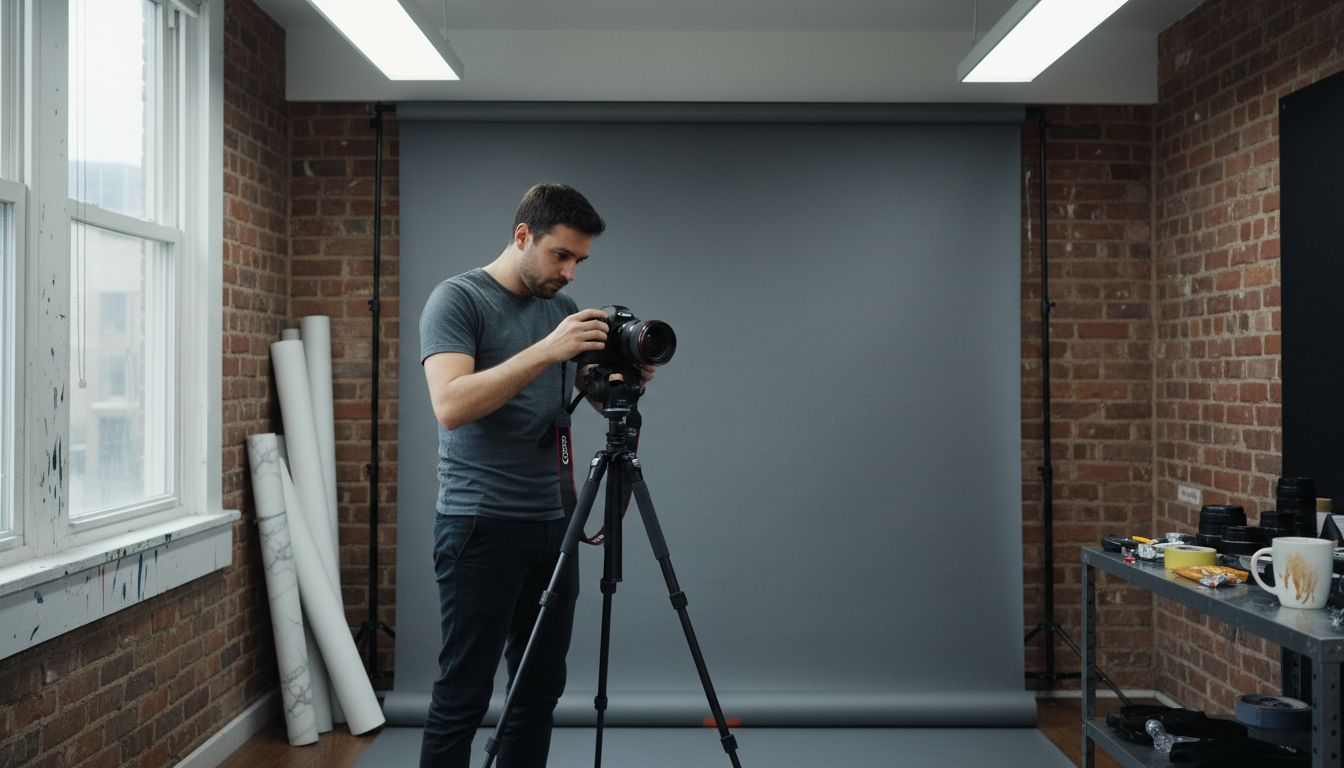
Photography studios prefer vinyl backdrops because they isolate the subject effectively and create consistent mood and atmosphere. This isolation means your products become the focal point—nothing competes for viewer attention. The background recedes visually, allowing your product’s colors, textures, and details to dominate the frame.
Subject Isolation and Focus
Vinyl provides clean, distraction-free backgrounds that keep attention exactly where you want it. When shooting e-commerce product photos, a neutral or thematic vinyl backdrop ensures your merchandise remains the visual hero.
This isolation delivers practical benefits:
- Reduces post-processing time: Less background noise means fewer edits required
- Maintains color accuracy: Controlled backdrop tones don’t skew white balance
- Improves product legibility: Customers see clearly what they’re purchasing
- Creates professional aesthetics: Consistency across product catalogs builds brand trust
- Simplifies composition: You focus on product placement, not background management
The psychological effect matters too. Viewers unconsciously trust product photos with clean, professional backgrounds. Your items appear more valuable and carefully presented.
Consistency Across Shooting Sessions
Vinyl maintains identical appearance from your first shot to your hundredth. No fade, no wrinkles, no unexpected color shifts. This consistency transforms your editing workflow. You can apply the same color correction and lighting settings to entire batches of photos.
Consistent backgrounds mean you’re not fighting variables between sessions. The marble vinyl you shoot on Tuesday looks identical to Wednesday’s session. Your lighting setup translates predictably across days and weeks.
Vinyl’s resistance to wrinkles and matte finish help photographers achieve consistent lighting and distraction-free visuals across multiple shooting sessions.
This stability matters enormously for e-commerce sellers managing large product catalogs. You develop one reliable setup, then replicate results indefinitely.
Speed and Efficiency
Vinyl backdrops enable quick setup and breakdown. Roll it out, secure it, start shooting. No complicated assembly. No waiting for fabric to settle or wrinkles to disappear.
When you’re shooting dozens of products daily, these minutes accumulate into hours saved weekly. Faster setup means more shooting time, higher output, and faster content delivery to your marketplace listings.
Pro tip: Keep your vinyl backdrop mounted on a permanent or semi-permanent stand if your studio space allows, eliminating setup time entirely and ensuring identical framing across all your product photography sessions.
Comparing Vinyl With Fabric and Paper Backdrops
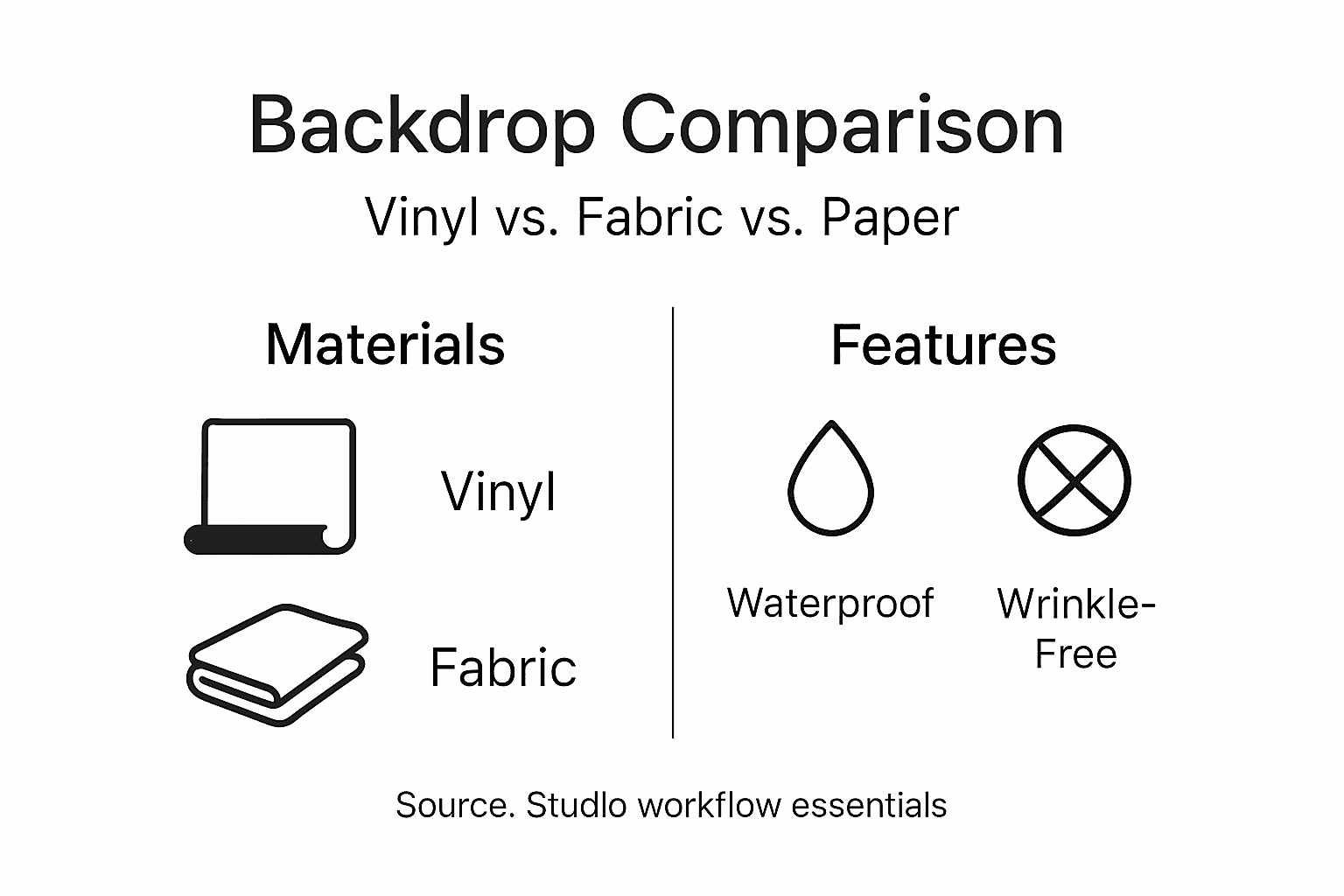
Choosing the right backdrop material impacts your entire workflow. Vinyl, fabric, and paper each deliver different strengths, and understanding these differences helps you make the right investment for your specific photography style.
Vinyl stands apart because it combines durability with practical convenience. The material choice fundamentally changes how you shoot, clean, store, and maintain your backgrounds over time.
Vinyl vs. Fabric Backdrops
Fabric backdrops offer softness and a natural aesthetic that some photographers prefer. However, they introduce challenges vinyl eliminates entirely.
Key differences include:
- Wrinkle management: Fabric requires steaming or careful handling; vinyl stays perfectly flat
- Stain vulnerability: Fabric absorbs oils and liquids; vinyl repels them completely
- Cleaning difficulty: Fabric needs gentle treatment or professional cleaning; vinyl wipes clean instantly
- Durability: Fabric fades and wears over time; vinyl maintains color indefinitely
- Portability: Heavy fabric requires special storage; vinyl rolls compactly
- Cost longevity: Fabric replacement costs accumulate; vinyl lasts years
Fabric works for portrait photographers seeking softer aesthetics. Product photographers overwhelmingly choose vinyl because the material protects against spills and maintains pristine appearance through hundreds of shoots.
The wrinkle issue alone makes vinyl superior for product work. You’re shooting close-ups where fabric texture becomes distracting. Vinyl’s smooth surface keeps focus on your merchandise.
Vinyl vs. Paper Backdrops
Paper backdrops are budget-friendly but fundamentally limited. They’re designed for one-time or limited use, not professional studios managing high volume.
Critical drawbacks of paper include:
- Fragility: Paper tears easily with minor contact or handling
- Water sensitivity: Any liquid spill permanently damages the backdrop
- Crease permanence: Folds or bends leave visible marks
- Short lifespan: Paper degrades after 20-30 uses
- Limited sizes: Paper rolls are smaller than vinyl options
- No reusability: Once damaged, paper backdrops go straight to trash
Paper backdrops offer initial cost savings but fail immediately when exposed to the spills and handling that characterize food and product photography.
For e-commerce sellers shooting regularly, paper becomes expensive fast. You’ll replace backdrops constantly, negating any initial savings. Vinyl’s upfront cost recovers quickly through longevity.
The table below summarizes backdrop material performance for product photography:
| Attribute | Vinyl Backdrop | Fabric Backdrop | Paper Backdrop |
|---|---|---|---|
| Lifespan | Years, minimal wear | Fades and stains easily | Single-use, tears fast |
| Cleaning effort | Wipes clean quickly | Needs complex washing | Cannot be cleaned |
| Color retention | Stays true over time | Fades with exposure | Loses vibrancy quickly |
| Setup speed | Instant, no wrinkles | Requires adjustment | Easy, but fragile |
The Practical Reality
Professional photographers choose vinyl because it combines durability with setup simplicity that fabric and paper cannot match. Vinyl eliminates variables that waste time and complicate post-processing.
When you’re shooting dozens of products weekly, vinyl’s reliability becomes invaluable. You’re not managing wrinkles, repairing tears, or replacing backdrops constantly. You’re shooting.
Pro tip: If budget is tight, start with one versatile vinyl backdrop in a neutral tone like grey or beige, then expand your collection as you grow rather than buying multiple paper backdrops you’ll quickly replace.
Choosing the Right Vinyl Backdrop for Your Setup
Selecting the perfect vinyl backdrop requires evaluating several critical factors. Your choice directly impacts image quality, shooting efficiency, and long-term value. The right backdrop transforms your studio; the wrong one creates unnecessary frustration.
Start by assessing your specific needs. What are you shooting? How much space do you have? Will you move your backdrop between locations? These answers guide every decision that follows.
Size and Space Considerations
Backdrop size must match both your subject and shooting space. Standard sizes like 5x7 feet work for most product and food photography, providing enough coverage for full compositions and flat lays without overwhelming smaller studios.
Consider your actual shooting area before purchasing. Measure your space, account for lighting stands and camera positioning, then choose a size that fits comfortably.
Key sizing factors include:
- Subject coverage: Ensure the backdrop extends beyond your product’s edges
- Camera distance: Account for the space you need between camera and backdrop
- Lighting placement: Lights require room around your shooting setup
- Background blur: Larger backdrops allow more distance, creating better background separation
- Storage space: Rolled vinyl requires horizontal or vertical storage
Larger isn’t always better. A 5x7 backdrop works for 90% of product photography. Oversized backdrops waste money and consume valuable studio real estate.
Material Quality and Durability
Vinyl thickness matters significantly for durability and permanence. Minimum 0.35mm thickness ensures your backdrop resists permanent creasing and maintains its shape through hundreds of uses.
Avoid ultra-cheap options under $20. Budget backdrops crease permanently and fade quickly, creating false economy. You’ll replace them constantly, ultimately spending more than quality alternatives.
Higher quality vinyl with photorealistic prints and minimum 0.35mm thickness costs more upfront but lasts years and maintains appearance indefinitely.
Look for backdrops with reinforced edges or grommets for stable mounting. These hardware features prevent tears at stress points and simplify hanging systems.
Finish and Color Selection
Matte finishes are non-negotiable for product photography. Glossy vinyl reflects lights and creates hot spots that complicate your lighting setup. Matte surfaces reduce glare and improve your ability to control light precisely.
Color and texture selection depends on your product category. Neutral tones like grey, beige, or white work universally. Textured options like marble, wood, or concrete add visual interest without overwhelming products. Avoid bold colors unless you’re shooting specific product categories where contrast matters.
Mounting and Stability
Professional backdrops include rod pockets or grommets for hanging. These mounting options simplify setup and ensure your backdrop stays perfectly positioned during shooting. Unstable backdrops shift during shoots, ruining consistency across images.
Choose a mounting system compatible with your studio space. Wall-mounted rods, stands, or frame systems all work; pick whichever suits your setup.
Pro tip: Store vinyl backdrops rolled around a tube rather than folded, keep them in a cool, dry space away from direct sunlight, and gently hand-wash or wipe surfaces after shoots involving oils or food residue to maximize lifespan.
Discover Vinyl Backdrops That Solve Your Photography Challenges
The article highlights common struggles photographers face with backdrops such as stains, wrinkles, and inconsistent textures that slow down your workflow and impact image quality. If you need durable, waterproof, and matte vinyl backdrops that stay flawless through every shoot, Instant Backdrops offers premium solutions designed exactly for these pain points. Our collections provide ultra-realistic prints and large sizes ideal for food, product, and e-commerce photography — all built to withstand spills and maintain perfect subject isolation.
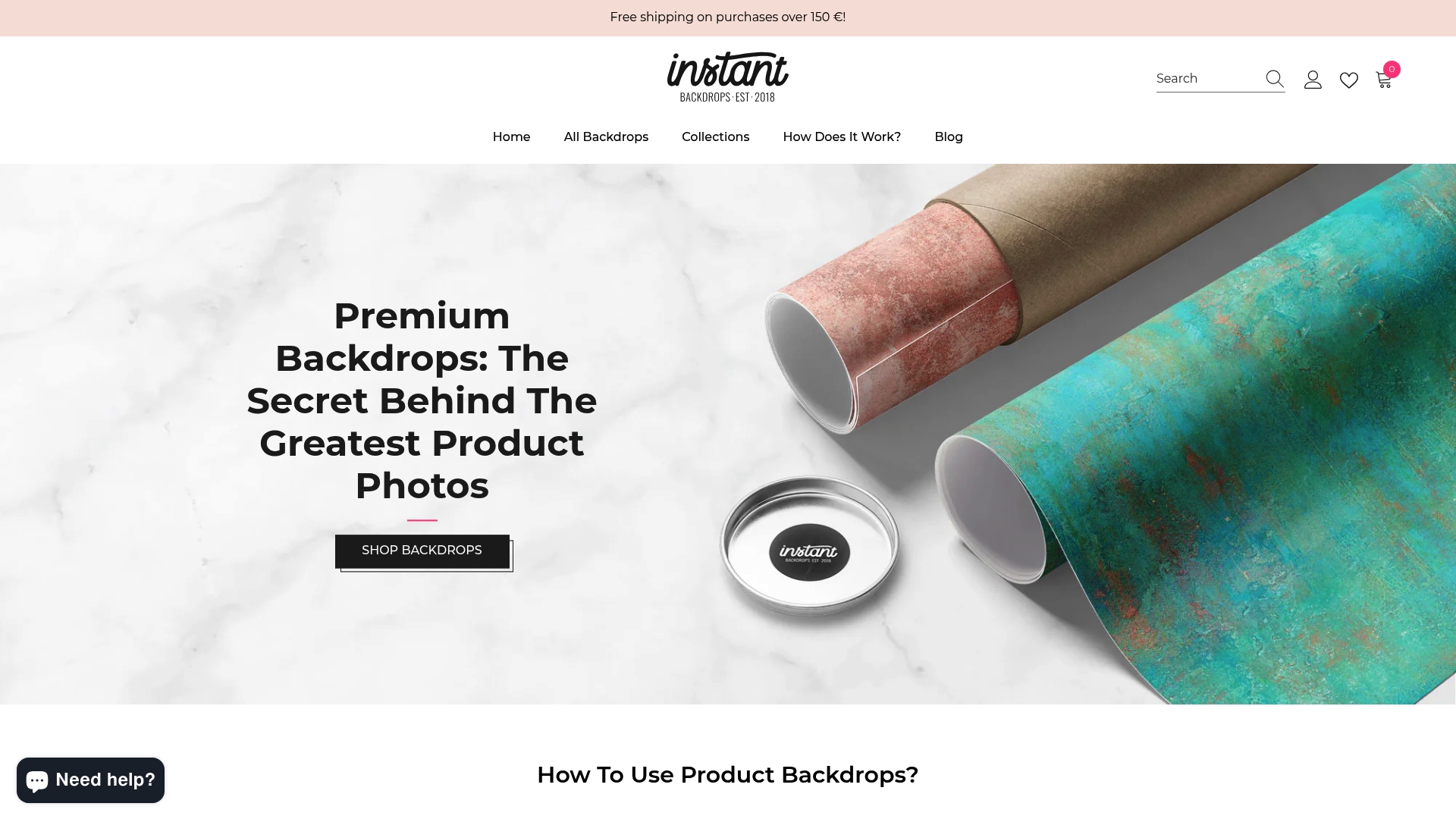
Explore the Aristocrat backdrop collection for product & food photography – Instant Backdrops to find highly detailed, resilient vinyl options tailored to professional needs. Ready to upgrade your studio setup with the reliability vinyl offers? Visit All product photography backdrops – Instant Backdrops and discover styles that elevate your visuals while saving you time and effort. Experience the difference at Instant Backdrops today and never worry about your background holding back your creative potential.
Frequently Asked Questions
What are the main advantages of using vinyl backdrops in photography?
Vinyl backdrops offer several advantages including waterproof and stain-resistant properties, a matte finish that reduces glare, a wrinkle-free surface, ease of cleaning, and consistent texture that maintains realism in product shots.
How do vinyl backdrops compare to fabric and paper backdrops?
Vinyl backdrops are more durable and easier to clean than fabric backdrops, which often require steaming and are susceptible to stains. Unlike paper backdrops, vinyl can withstand multiple uses without tearing or degrading, making it a more cost-effective solution for professional photography.
What types of vinyl backdrops are available for photography?
There are two main types: pure vinyl, which provides maximum durability and a flat surface, and vinyl-canvas blends that prioritize portability while still delivering professional quality. Each type caters to different shooting scenarios and preferences.
How can I ensure my vinyl backdrop stays in good condition?
To maintain your vinyl backdrop, store it rolled around a tube rather than folded, keep it in a cool, dry space away from direct sunlight, and gently wipe it clean after shoots, especially after working with messy products or food.